Locations
Harry Potter in Britain: real locations and soundstages
Platform 9 3/4, the Leaky Cauldron door, the Oxford staircase and the Glenfinnan Viaduct: a London tour leader on what you can really visit, what was built at Leavesden, and how to plan it.
Photo: Scenes Found
I have lived in London for fifteen years, and the question I hear most from American visitors is a simple one: where can I see Hogwarts? The honest answer is that you cannot, because Hogwarts was never one place. It was a model, a few soundstages and a dozen real buildings around Britain, each lending a staircase, a corridor or a courtyard. Once you know which is which, planning a Harry Potter trip gets much easier, and much more fun.
Most of it was built at Leavesden
The eight films were made between 2000 and 2010 at Leavesden Studios, an old aircraft factory near Watford, about 20 miles north of central London. The Great Hall, Dumbledore's office, the Gryffindor common room, Diagon Alley and the Ministry of Magic were all sets there. Many of them survived, and since 2012 they have been the Warner Bros. Studio Tour London, The Making of Harry Potter.
It is a public attraction, and you need a timed ticket bought in advance. There is no ticket office for walk-ups. Weekends and school holidays sell out months ahead. Plan on three to four hours inside, and do not rush the end: the large model of Hogwarts castle, used for the wide shots in all eight films, is in the last room, and people stand in front of it for a long time.
A few things surprise first-timers. The Great Hall is smaller than it looks on screen. The Hogwarts Express engine and a length of platform are inside, under cover. And the Diagon Alley street is real enough to walk down, with the shopfronts of Ollivanders and Gringotts on either side.
What you can see in London
- King's Cross. Harry looks for Platform 9 3/4 here in the first film. The scenes were shot on real platforms, between platforms 4 and 5. The trolley half sunk into a brick wall is in the Western Concourse, next to a shop. Come before 9 a.m. for a short line.
- St Pancras. The red brick station next door is the outside of King's Cross in Chamber of Secrets, when Harry and Ron fly off in the Ford Anglia.
- Leadenhall Market. The Victorian market in the City played part of the way into Diagon Alley in Philosopher's Stone. The door of an empty shop on Bull's Head Passage was painted for the film and used as the entrance to the Leaky Cauldron. It is an optician today. The market is mostly closed at weekends, so go on a weekday.
- The Millennium Bridge. The footbridge from St Paul's to Tate Modern is the one the Death Eaters twist apart in Half-Blood Prince. The destruction was all visual effects, and the bridge carries thousands of people a day.
All four fit easily into one morning, which is why our London day tour does exactly that before driving out to Leavesden after lunch.
Oxford, Lacock and Gloucester: the corridors of Hogwarts
The real stone of Hogwarts is mostly in the south and west of England. At Christ Church in Oxford, the fan-vaulted staircase up to the dining hall is where Professor McGonagall waits for the first years. The dining hall itself was not used for filming, even though every guide in town will tell you about it. It was the model for the Great Hall set at Leavesden, which is a different thing. Across town, the Divinity School of the Bodleian Library played the hospital wing and, in Goblet of Fire, the room where McGonagall teaches the students to dance.
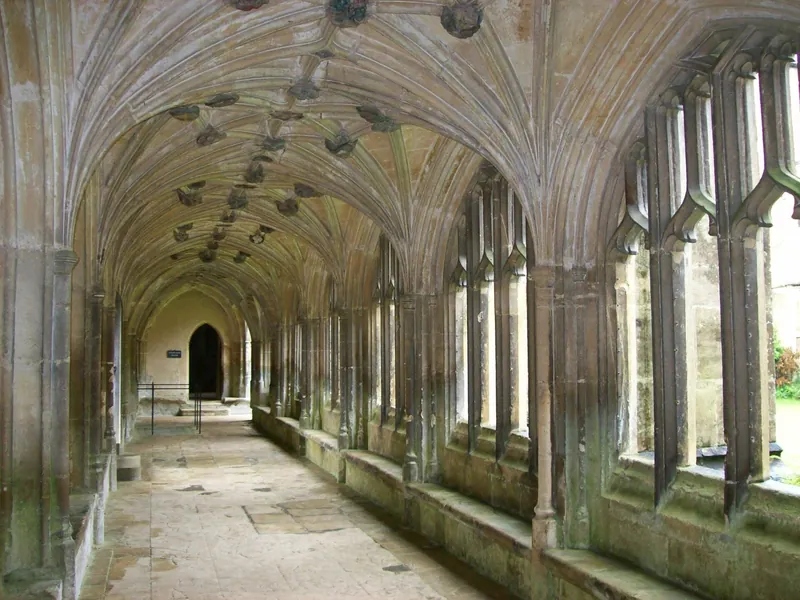
Lacock Abbey in Wiltshire gave the first two films their cloisters, plus three classrooms: the sacristy for Snape's potions lessons, the warming room for Professor Quirrell, and the chapter house, where Harry finds the Mirror of Erised. The village around it is owned by the National Trust and looks almost unchanged since the 18th century, which is also why the BBC filmed Pride and Prejudice there in 1995. Gloucester Cathedral, an hour north, has the fan-vaulted cloister you see when the students walk between classes, and it is one of the most beautiful rooms in England, film or no film.
All three are working places: a college, an abbey house and a cathedral. Opening hours change for services, exams and private events, so always check the day before. On our tour I phone ahead.
The north: Goathland, Alnwick and Glenfinnan
Goathland, a small station on the North Yorkshire Moors Railway, is Hogsmeade station in the first film. It still looks the part, and arriving by steam train is the best way to see it. Alnwick Castle in Northumberland is where Madam Hooch gives the flying lesson, and the castle now runs free broomstick classes in the same courtyard. It is open from late March to the end of October only.
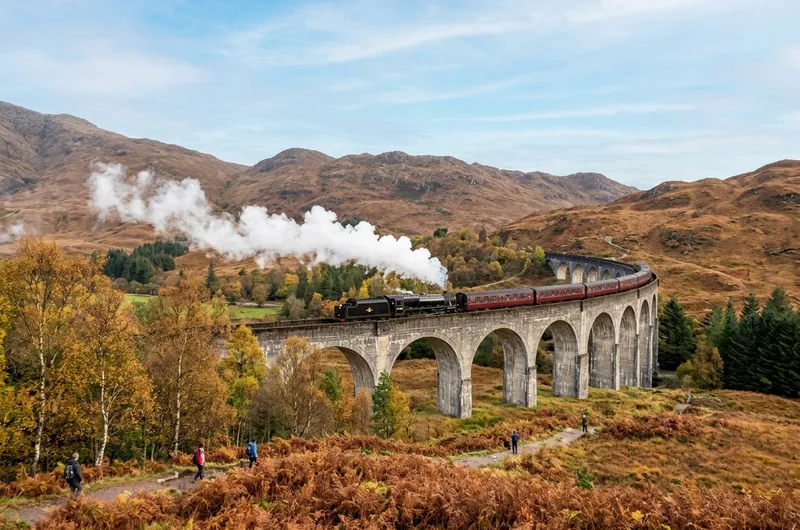
Then there is the Glenfinnan Viaduct in the West Highlands, the curved stone bridge the Hogwarts Express crosses on its way north. The Jacobite steam train runs over it between Fort William and Mallaig, from spring to autumn, and seats in summer sell out early. If you only want the photo, walk up the signed path from the Glenfinnan visitor center and wait for the train on the hillside. The morning service passes in the late morning; ask at the visitor center for the time that day.
Edinburgh, where the books were written
J.K. Rowling lived in Edinburgh while she wrote the early books, often in cafes. The Elephant House on George IV Bridge, which calls itself the birthplace of Harry Potter, reopened in late 2025 after a fire in 2021. Greyfriars Kirkyard behind it has a gravestone for a Thomas Riddell, and fans leave notes there. Please do not climb on the old stones. Victoria Street, curved and colorful, is often said to have inspired Diagon Alley. Nobody has proved it, but it is a lovely street either way.
When to go
- April to early October is the season for a full trip. The Jacobite, Alnwick and the Goathland steam trains all run, and the days are long.
- May, June and September are the best months: 60 to 70 F, fewer school groups and light evenings.
- Winter is good for London alone. The studio tour adds snow to the Great Hall for the holidays, and the city streets are quieter.
One last piece of advice: watch the first two films again before you come. They used real places far more than the later ones, and you will recognize corners you never noticed.