Locations
The Sound of Music in Salzburg: what the film changed
The Mirabell steps, the moving gazebo, a villa made of two palaces and a wedding moved out of town: a Salzburg tour leader on the real story, the film locations and how to plan your visit.
Photo: Scenes Found
I grew up in the Salzkammergut, and I was a teenager before I saw The Sound of Music. That surprises my American guests more than anything else I tell them. The film is part of almost every American childhood, but most Austrians my age did not grow up with it. Salzburg came to know it through its visitors, who have been arriving with the songs in their heads since 1965. I have led Sound of Music days here for twelve years, and these are the things I find myself explaining most often.
The real Maria and the film Maria
The film is based on a Broadway musical, which was based on a memoir by Maria von Trapp herself, published in 1949. Each step moved the story a little further from what happened.
- Maria came as a tutor, not a governess. In 1926 the young Maria Kutschera, then a novice at Nonnberg Abbey, was sent to the von Trapp house to teach one of the children, who was recovering from an illness. She was not hired to look after all seven.
- The Captain was not cold. Georg von Trapp, a former naval officer, was by his family's account a warm father who loved music. The whistle and the stern manner were added for the stage.
- The wedding was at Nonnberg. Maria and Georg married in 1927 in the abbey church at Nonnberg, more than ten years before the family left Austria. The film moved the wedding to the eve of the Nazi takeover and to a church in Mondsee.
- Nobody climbed over the mountains. The family left in 1938, after the annexation of Austria, by train, and ended up in the United States, where they toured as singers and settled in Stowe, Vermont. Locals like to point out that the mountains behind the famous final scene would have led the family toward Germany, not away from it.
- Edelweiss is not a folk song. It was written by Rodgers and Hammerstein for the musical. I have had guests ask me to sing the Austrian national anthem, meaning Edelweiss. It is not, but it is a lovely song.
None of this spoils the film for me. It is a musical, not a documentary. But knowing the real story makes the places more interesting.
What you can still see in the city
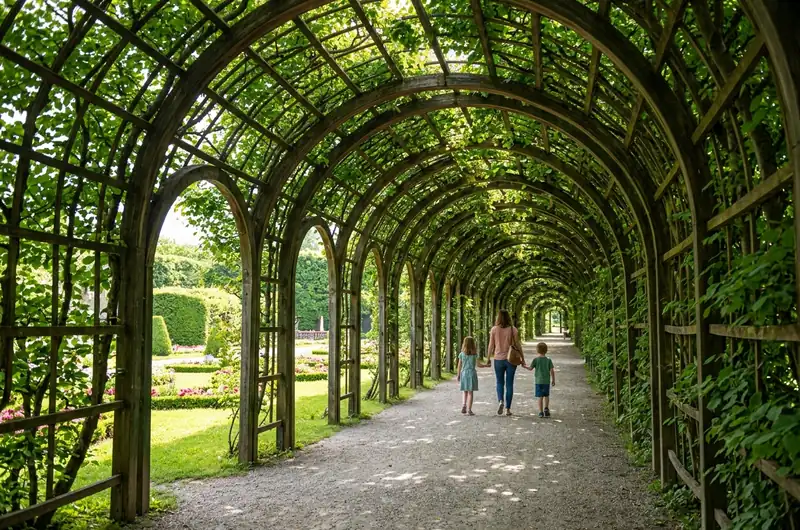
The Mirabell Gardens are the easiest to find and the most rewarding. The end of Do-Re-Mi was shot here: the children march around the Pegasus fountain, past the stone dwarfs, through the hedge tunnel and up the steps, where they finish on the high note with the fortress behind. The gardens are free, open every day, and at their best before 9 in the morning.
Nonnberg Abbey sits on the hill below the fortress. It is one of the oldest convents in the German-speaking world and a working community of Benedictine nuns, so most of it is closed to visitors. You can visit the church and stand at the entrance court where the children come to the gate asking for Maria. It is a short, steep climb from the old town, and very quiet.
Other spots in the old town turn up in the film too: the horse pond near the Festival Hall and the Mozart footbridge in Do-Re-Mi, and the Residenzplatz fountain, which Maria splashes on her way to the villa in I Have Confidence. Walk them with the scene on your phone and you will spot them quickly.
The villa that was two palaces
There is no von Trapp villa as you see it in the film. The lakeside terrace, where the children fall out of the boat, belongs to Leopoldskron Palace, an 18th-century palace that is now a hotel and conference center. The front of the house, with the gate and the long wall, is Frohnburg Palace, a yellow building on Hellbrunner Allee that belongs to the university. Both are private. The best public view of Leopoldskron is from the path on the far side of the pond, which is where I take my groups.
The real von Trapp home was a different villa altogether, in the Aigen district on the other side of the river.
The gazebo that moved
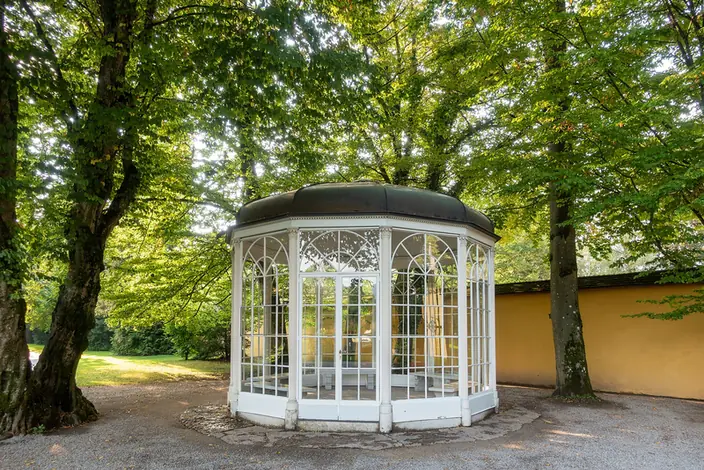
The glass gazebo of Sixteen Going on Seventeen was built for the film in the grounds of Leopoldskron. Fans kept walking onto the private estate to see it, so in the end it was taken down and rebuilt in the public park of Hellbrunn Palace, south of the city. It is smaller than you expect. That is because the singing and dancing inside were filmed on a soundstage in Hollywood, in a larger copy. The doors are locked these days, but you can walk all round it and take your photos, and the park is free.
The lakes and the wedding church
The film opens with the camera flying over the lakes and mountains of the Salzkammergut, east of the city. You can see that country in an afternoon. St. Gilgen on the Wolfgangsee is my favorite lunch stop: a small town on a turquoise lake, with boats across to St. Wolfgang. Twenty minutes north is Mondsee, whose yellow basilica of St. Michael is the church where Maria walks up the long aisle to marry the Captain. It is a parish church, so check that no service is on before you go inside.
When to come to Salzburg
- May, June and September are best: green hills, 65 to 75 F, and the gardens in flower.
- July and August bring the Salzburg Festival and the most visitors. Book hotels early.
- December has the Christmas markets and, sometimes, snow. The lakes are gray and quiet then, which has its own charm.
- Any month, pack an umbrella. Salzburg has a lot of rain, and locals call it the Schnurlregen, the string rain.
My last piece of advice is the same one I give on every tour: watch the film again the week before you come. You will recognize far more than you expect, and the city will feel like a place you already know.