Film and TV location tours since 2019

Search tours Get a quote
Two hikers crossing the Umm Fruth rock bridge in Wadi Rum, with sandstone cliffs behind

Destination guide

Jordan film location tours: Petra and the Wadi Rum desert

Six days from Amman to Petra and the Wadi Rum desert, with a night in a Bedouin camp and a tour leader who was born at the gate of Petra.

  • 1 tour
  • from $2,690 per person
  • Best months Mar to May, Oct to Nov
  • 5 filming locations

Further afield

Jordan on screen

Jordan gives film fans two of the most recognizable places on screen within two hours of each other. Petra is the rock-cut city of the Nabataeans, where the Treasury played the temple of the Grail in Indiana Jones and the Last Crusade. Wadi Rum, to the south, is the red desert of Lawrence of Arabia, and since the 2010s it has been the go-to planet for science fiction: Mars in The Martian, two Star Wars worlds and the Arrakis of Dune. Neither place needs a set. The rock and sand are the scenery, and both are open to visitors every day.

Our six-day trip runs from Amman down the King's Highway to Petra, where we spend two nights and one very full day, then on to Wadi Rum for a night in a desert camp run by a Bedouin family, and back to Amman on the Desert Highway. Omar Nawafleh, who lives in Wadi Musa and has guided in Petra for twelve years, leads the group. Inside Wadi Rum the jeeps are driven by Bedouin guides from Rum village, who know the valleys better than any map.

The filming locations below, on the map.Map: Esri, OpenStreetMap contributors

Filming locations

Petra and Wadi Rum on screen

The carved facade of the Treasury at Petra seen through the narrow end of the Siq

01

Al-Khazneh, the Treasury

Al-Khazneh, the Treasury, is the first great facade you meet in Petra, carved out of the rose-colored sandstone cliff by the Nabataeans about 2,000 years ago, most likely as a royal tomb. The name comes from a later legend of treasure hidden in the urn at the top. In Indiana Jones and the Last Crusade (1989) it is the entrance to the temple of the Holy Grail. Only the facade was filmed here: the passages and traps inside were sets built in a studio, and the real chamber behind the doorway is a plain rock room that visitors may not enter. We arrive early, before the day's crowds, and later climb a trail to a viewpoint that looks straight down on it. Petra has been a World Heritage Site since 1985.

  • The Grail temple facade from The Last Crusade
  • Early morning before the crowds
  • The view from the trail above
Best time
Before 8 a.m. or after 4 p.m., March to May and September to November

Tours that visit Al-Khazneh, the Treasury

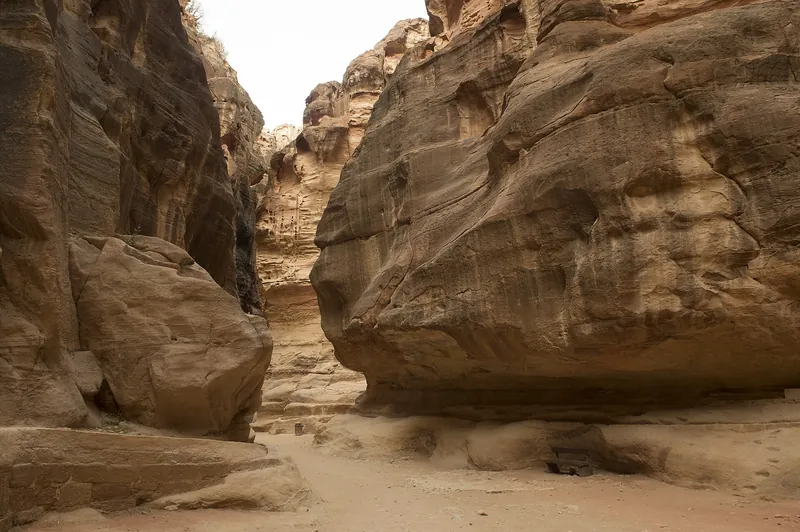
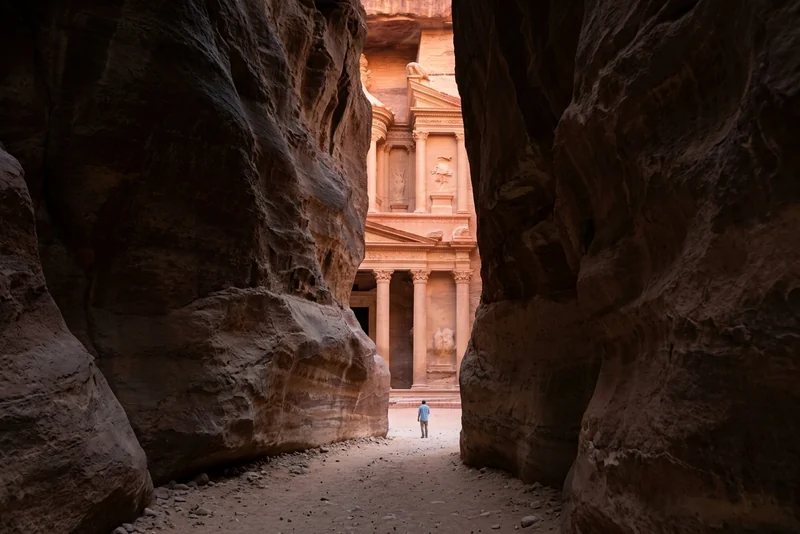
The narrow sandstone walls of the Siq, the gorge leading into Petra

02

The Siq

The Siq is the main way into Petra: a winding cleft through the mountain, about three quarters of a mile long, in places only about 10 feet wide, with walls up to about 260 feet high. It was split open by movements of the earth and then smoothed by floodwater. Along the sides you can still follow the channels the Nabataeans cut to carry water into the city, and stretches of their paved road. In The Last Crusade the Siq is the road to the temple, and its last bend, where a slice of the Treasury suddenly appears through the gap, is the view everyone remembers from the film. We walk it twice: in the morning light, and again at night for Petra by Night, when the path is lined with candles.

  • The last bend and the first glimpse of the Treasury
  • Nabataean water channels along the walls
  • The same path by candlelight at Petra by Night
Best time
Mid-morning, when light reaches the floor

Tours that visit The Siq

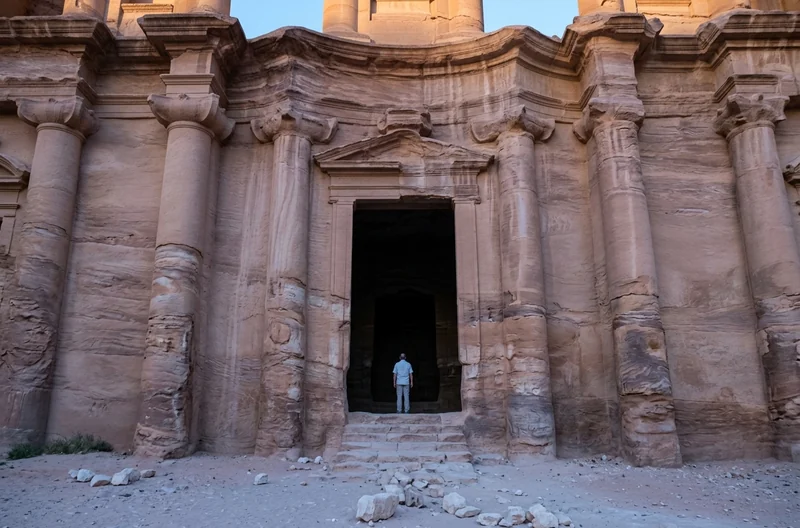
One visitor standing in the tall carved doorway of Ad Deir, the Monastery at Petra

03

Ad Deir, the Monastery

Ad Deir, the Monastery, is larger than the Treasury and far less crowded, because reaching it means climbing about 800 rock-cut steps from the old city center, some 45 minutes up a path through a gorge. The facade is about 150 feet wide and nearly as high, carved in the 1st century AD, and probably served as a temple or meeting hall; the name came later, from crosses cut on the inner wall in Byzantine times. It is not the star of a famous film, which is part of the reward: you sit with a mint tea at the stall opposite and look at it with a fraction of the crowd below. Donkeys work the trail, but we ask you to walk up if you can. Viewpoints beyond the Monastery look west over the Wadi Araba.

  • About 800 steps up through a gorge
  • Mint tea facing the facade
  • The view over the Wadi Araba
Best time
Climb in the morning shade, sit in the afternoon sun

Tours that visit Ad Deir, the Monastery

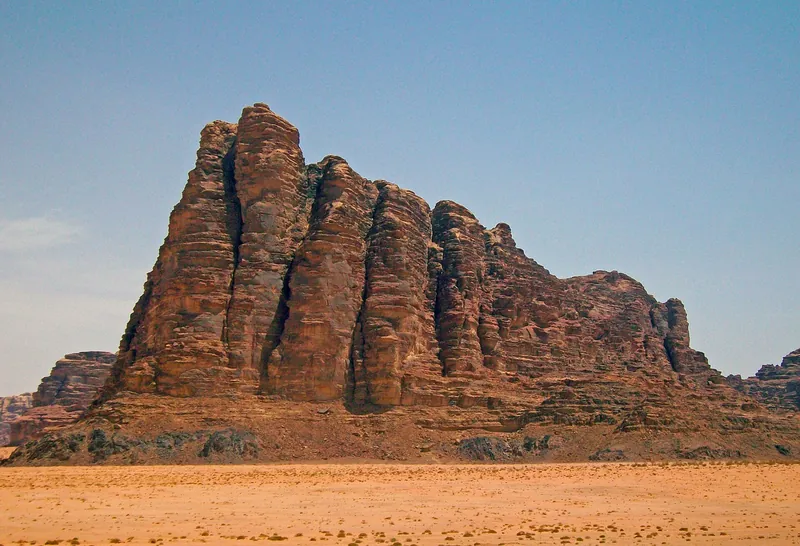
The Seven Pillars of Wisdom rock above the Wadi Rum visitor center

04

Wadi Rum village and the Seven Pillars

Wadi Rum is a protected desert of sandstone and granite mountains in the far south of Jordan, a World Heritage Site since 2011 and home to the Zalabia Bedouin, who live in Rum village and run the jeeps, camps and guiding inside the reserve. At the visitor center, the long fluted mountain in front of you is called the Seven Pillars of Wisdom, after the book in which T.E. Lawrence described this valley. David Lean filmed parts of Lawrence of Arabia (1962) in Wadi Rum, and the light on these walls is the light of the film. One honest note: the attack on Aqaba in the film was shot on a set built on a beach in Almería, Spain. In the village we leave our van and climb into the Bedouin jeeps.

  • The Seven Pillars of Wisdom from the visitor center
  • Lawrence of Arabia country
  • Bedouin jeeps from Rum village
Best time
Late afternoon, October to April

Tours that visit Wadi Rum village and the Seven Pillars

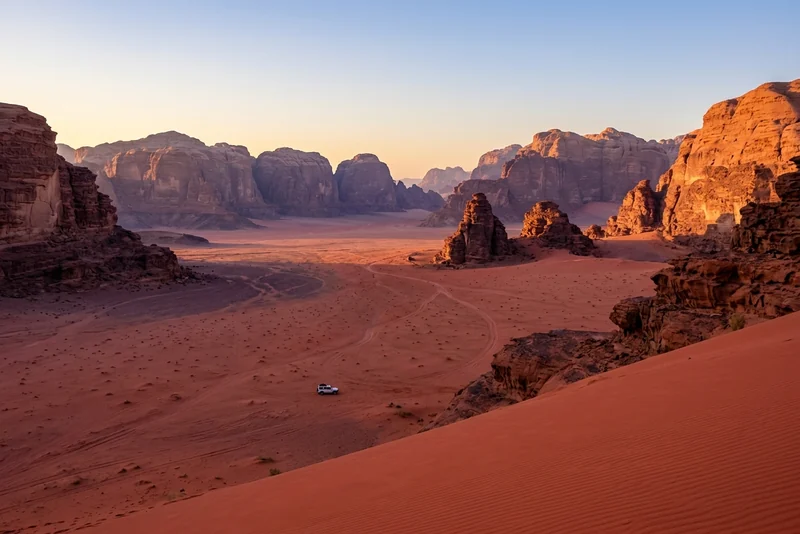
Red dunes and sandstone towers of Wadi Rum at sunset, with a lone white jeep

05

The deep desert of Wadi Rum

Past the village the valleys open out into red sand, dunes and lone rock towers, and this is where the newer films come. Ridley Scott filmed the surface of Mars for The Martian (2015) here. Star Wars used the reserve twice: as the desert moon Jedha in Rogue One (2016) and as the planet Pasaana in The Rise of Skywalker (2019). Denis Villeneuve's crew spent more than three weeks in Jordan for Dune (2021), filming Arrakis in Wadi Rum and the Wadi Araba, and Aladdin (2019) also shot in the reserve. No sets are left; these are open valleys where the jeeps drive. Our Bedouin drivers know which valley played which planet, and we stop at rock bridges, a narrow canyon with ancient inscriptions and a red dune at sunset.

  • The Mars of The Martian
  • Jedha and Pasaana from Star Wars
  • Sunset from a red dune
Best time
Sunset and sunrise, October to April

Tours that visit The deep desert of Wadi Rum

Jordan film location tours for 2026 and 2027

Price per person sharing a double room; day tours per person. Flights to the start city are not included.

Compare with all tours

1 tour

Getting around

How our tours get around Jordan

01

A van with a driver on the highways

Between Amman, Petra and Wadi Rum we travel in an air-conditioned van with a professional Jordanian driver. The longest drive is the run back to Amman on the Desert Highway, about four hours with a break.

02

On foot in Petra

Petra is a walking site. On the big day you walk 6 to 9 miles on sand, stone paths and steps, at your own pace, with Omar choosing the order so the main sights are in good light. Horse carriages and donkeys exist, but walking is the best way to see it.

03

Jeeps with Bedouin guides in Wadi Rum

Private cars cannot drive into the deep desert. Inside the reserve we ride in open 4x4 pickups with bench seats, driven by Bedouin guides from Rum village, two afternoons and one morning in all.

What is included

What our Jordan tours include

In Jordan

  • A Jordan Pass bought in your name, covering the visa fee and two days of entry to Petra
  • A ticket for Petra by Night
  • A night in a Bedouin-run desert camp with dinner cooked in the sand
  • Jeep drives in Wadi Rum with local Bedouin guides
  • Omar Nawafleh, our Jordan tour leader, from arrival to departure
  • An air-conditioned van with a professional driver for every transfer
  • Stops at Madaba, Mount Nebo and Kerak Castle on the King's Highway

On every tour

  • Central hotels with daily breakfast on trips of two days or more
  • A named Scenes Found tour leader with the group from the first day to the last
  • Airport transfers on the first and last day of the tour
  • Hotel taxes, parking, park entry and local guide fees
  • Our 24/7 line while you travel, in every time zone

Not included: flights to the start city and home, meals not listed, drinks, tips and travel insurance. Each tour page lists exactly what is in the price.

Best time to go

Best time to visit Jordan

Spring and autumn are the seasons for Petra and Wadi Rum. From March to May days are 70 to 85 F, the hills around Petra turn briefly green and wildflowers come up in the desert. October and November are warm, clear and dry, and the light is soft for photos. July and August are too hot for a full day of walking in Petra, often above 95 F, and we do not run the tour then. Winter is cool and quiet, 55 to 60 F by day, with a chance of rain in Petra and nights near freezing in Wadi Rum, so pack a warm layer for the camp in any month.

  1. Jan: good months
  2. Feb: good months
  3. Mar: best months
  4. Apr: best months
  5. May: best months
  6. Jun: good months
  7. Jul: no departures
  8. Aug: no departures
  9. Sep: good months
  10. Oct: best months
  11. Nov: best months
  12. Dec: good months

Best monthsGood monthsNo departures

Practical

Jordan at a glance

Best months
Mar to May, Oct to Nov
Airport
Queen Alia International (AMM), about 22 miles south of Amman, 40 to 50 minutes to the city; you fly home from the same airport
Getting around
Our van and driver on the highways, walking in Petra (6 to 9 miles on the big day), and open jeeps with Bedouin drivers in Wadi Rum
Time zone
Jordan stays on UTC+3 all year: 7 hours ahead of New York in summer, 8 hours in winter
Weather
Spring and autumn 70 to 85 F by day; nights in Wadi Rum drop into the 40s F in March and November; July and August often pass 95 F
Filming today
International productions shoot in Wadi Rum and the Wadi Araba often. When a crew is working, parts of the reserve may close for some days, and our Bedouin guides change the route.
Location etiquette
Dress modestly in towns, with shoulders and knees covered; ask before you photograph people, especially women; do not climb on carved facades in Petra
Book ahead
Petra and Wadi Rum entry come with the Jordan Pass, which we buy in your name before you travel; Petra by Night is a separate ticket, also included
Tipping
Tips are expected: about 10 percent in restaurants, small notes for drivers and porters, and for your tour leader and Bedouin guides at your discretion
Entry rules
US citizens need a passport valid for at least six months from arrival and a tourist visa, which is issued on arrival at Queen Alia airport. With a Jordan Pass bought before you land and a stay of at least three nights, the visa fee is waived. We buy the pass in your name, so at immigration you simply show it with your passport.

FAQ

Jordan tour FAQs

More on the FAQ page, or call +1 (323) 641-2870.

Can we go inside the Treasury?

No. The chamber behind the doorway is closed to visitors to protect it, and it is a plain rock room anyway. The Grail temple interiors in The Last Crusade were sets built in a studio, far from Jordan.

Is Jordan safe to visit?

Jordan has a long record of welcoming visitors, and Petra and Wadi Rum are its best-known sights. We follow the US State Department advisories closely, and if anything changes before your departure we contact you and explain your options.

How hard is the walking in Petra?

From the gate to the Treasury is about a mile, downhill on a sandy path; the old city center is another mile. The Monastery adds about 800 steps each way. You can turn back at any point, and Omar plans the day so that you choose how far to go.

What is the desert camp like?

It is run by a Bedouin family inside the reserve. Tents are private, with real beds and their own bathroom. Dinner is usually zarb, meat and vegetables cooked in a pit under the sand. Nights are quiet and very dark, and the stars are the evening program.

Was Lawrence of Arabia really filmed in Wadi Rum?

Parts of it, yes, in 1961, and you see Wadi Rum's mountains in several desert scenes. Much of the film was shot in Spain and Morocco, including the attack on Aqaba, which used a set on a beach in Almería. We are happy to tell you which is which.

Will we see a film being shot?

Probably not, and nobody can promise it. Productions do work in Wadi Rum often, and if one is on while we are there, the Bedouin guides will tell us which valleys are closed.

Can I add a day at the Dead Sea or in Aqaba?

Yes. Many travelers add two nights at the Dead Sea, an hour from Amman, or in Aqaba on the Red Sea, an hour from Wadi Rum. We can book the hotel and the transfer before or after the tour.

Planning Jordan?

Tell us when you can travel, who is coming and the films and shows you love. A travel advisor replies within one business day with dates and prices.